
What is Myostatin?
Myostatin is a natural protein in cattle that controls muscle development. Natural mutations of the gene reduce the protein’s ability to limit muscle growth, causing animals to develop more muscle mass. Myostatin is additional information that may be used when making breeding decisions, but it
should be interpreted alongside breeding indexes. It is inherited from both sire and dam, meaning the combination passed to a calf affects its growth, muscling and ease of birth.
Cattle inherit one copy of each myostatin mutation from each parent. For each myostatin mutation, an animal can have:
0 copies (homozygous free): Two working copies of the gene – normal muscling
1 copy (heterozygous): One working copy, one mutated – moderate muscling
2 copies (homozygous): Both copies mutated – double muscling
How can knowing my myostatin benefit me?
- It increases muscle mass and growth
- Knowing the genetics of both parents allows for more informed mating decisions
- Some myostatin can lead to health difficulties such as reduced fertility which can impact herd
productivity.
Myostatin frequency in beef cattle breeds
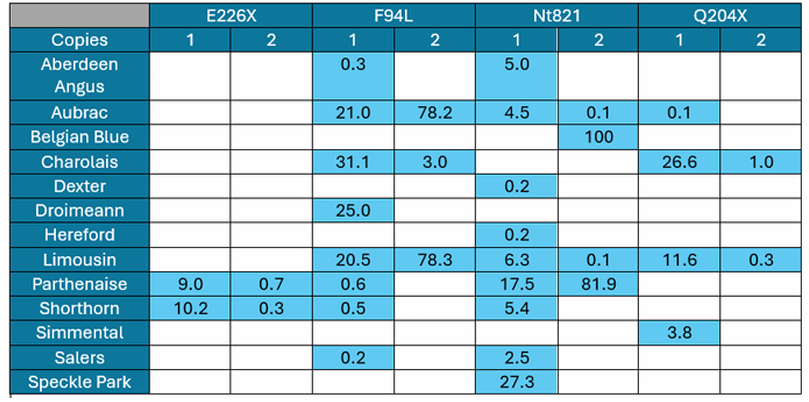
Different myostatin variants vary in their effects, as some are more disruptive to gene function than others. Those classed as disruptive include Nt821, Q204X, Nt419, E226X, C313Y and E291X while F94L, S105C and D182N are not as disruptive. Alongside this, calving difficulty and carcass merit are antagonistically genetically correlated in cattle, meaning that bulls selected to minimize calving difficulty generate calves with inferior carcass merit (Berry et al., 2019). Table 1 outlines the frequency of segregating myostatin variants in purebred breeds.
Table 1. Percentage of animals carrying one or two copies of segregating myostatin variants in the most common beef breeds (based on purebreds only).1
Key Myostatin Mutations
There are numerous types of myostatin mutations with some common mutations influencing on muscle development, carcass merit and calving performance these are explained below:
Animals carrying one copy (heterozygous) typically display moderate expression of traits.
Animals carrying two copies (homozygous) generally show a more pronounced effect.
F94L
The F94L gene is commonly known as the ‘profit gene’ animals with a copy of this gene can show improved carcass traits with no associated increased calving difficulty.
- Leaner carcasses and more tender beef due to increased muscle fibres.
- Heavier calves causing possible calving difficulties.
Q204X
The Q204X mutation is associated with improved carcass quality and increased muscle mass.
- Leaner carcasses with reduced external fat, greater loin depth, muscling expression and improved meat tenderness.
- Heavier birth weights in calves resulting in potential reduction in maternal calving ease. Some cows might also have slightly lower milk production.
NT821
NT821 is associated with improved carcass quality and increased muscle mass.
- Increased muscle development, improved feed efficiency and lower fat deposition.
- Heavier birth weights resulting in increased risk of calving difficulties. Some cows can also have limited pelvic capacity causing further calving difficulties.
E226X
E226X is a myostatin mutation linked to lean muscle growth and improved carcass traits.
- Leaner carcasses, improved meat tenderness and increased muscle fibers.
- Heavier birth weights and possible calving difficulties.
Effects of Myostatin Mutations on Carcass Traits
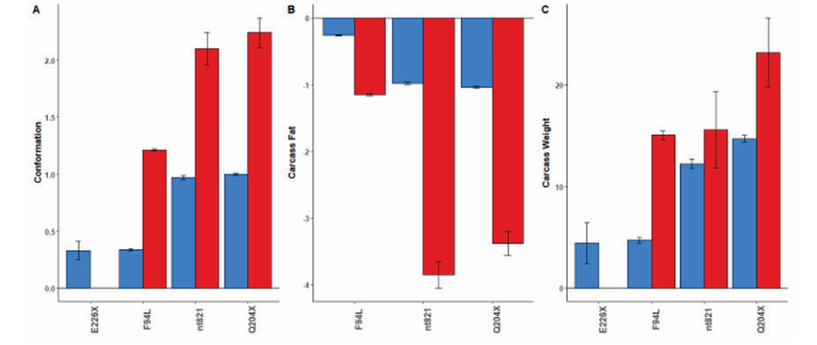
Graph 1: The average effect of carrying one or two copies of each myostatin mutation on carcase conformation, fat score and weight, relative to animals carrying no copies of the mutation. Conformation and fat scores are measured on a 1 to 15 scale (blue denotes one copy, red shows two copies of the mutation). Double carries of the mutated gene, show higher carcase conformation, higher carcase weight and less carcase fat.2
Additional Myostatin information sourced here: https://www.veterinaryirelandjournal.com/images/2025/november2025/lace_nov_2025.pdf