
Crossbreeding and Hybrid Vigour
Crossbreeding is the deliberate mating of animals from different breeds or strains designed to take advantage of heterosis (hybrid vigour) for characteristics like production, fertility and longevity.
Crossbreeds can be genetically evaluated in the UK.
Heterosis/ hybrid vigour
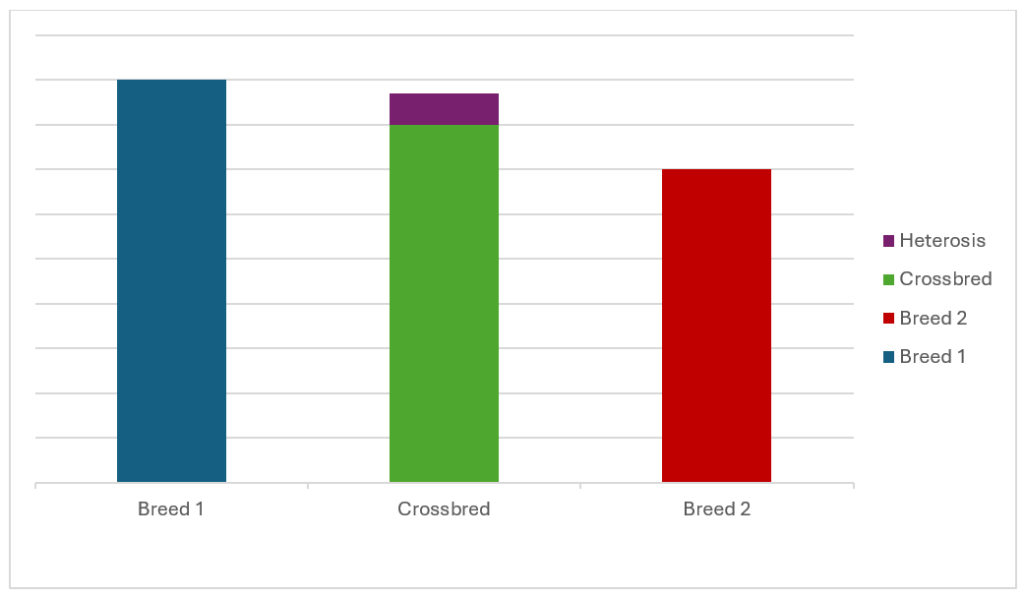
Heterosis/hybrid vigour is the tendency of a crossbred animal to have qualities superior to that of either parent but not more than the dominant breed.
The graph shows how heterosis can be applied to all health or production traits if there is sufficient genetic difference between the two chosen breeds.
If breed 1 was crossed with breed 2, the green area of the crossbred would be the logical average animal produced. The purple area on top of this is the added benefit, or heterosis, effect. The heterosis effect is variable between breeds and also the traits affected.
Trial work shows that heterosis mainly benefits fitness and health traits. Trials in California and New Zealand recorded around 10–18% heterosis across a wide variety of crossbred cows, including Swedish/Norwegian Reds (SRB), Brown Swiss, Jerseys, and Montbelliarde. Milk production can improve by up to 6%, but this is not the only measure of profitability.
Heterosis/ hybrid vigour
To gain and maintain the effects of heterosis, breed and bull selection is paramount. To maximise the benefits, farmers need to plan the long-term direction they want their business to ensure cross breeding is the right path for them.
Crossbreed genetic evaluations
The Spring Calving Index (£SCI) and Autumn Calving Index (£ACI) help farmers select sires for crossbreeding more easily.
Farmers who are spring or autumn-block calving should use these as initial filters to compare all bulls of interest then narrow down on the traits they wish to improve within their herd. All-year-round farmers looking to crossbreed should use the £ACI.
- 2 Way Cross – 67%
- 3 Way Cross – 85%
- 4 Way Cross – 94%
Although a four-way cross system provides maximum gain from heterosis, it is widely recommend a three-way cross is a more sustainable option.
Issues of using a four-way cross include:
- Difficult to implement
- Choosing four suitable breeds can be a problem
- Each cross reduces the strength of individual breed qualities
Farmers should not use heterosis as the main reason to crossbreed; they should treat it as an added bonus. It is important to remember that crossbreeding is about herd improvement, not breed improvement.
Crossbreed genomics
Crossbred genomics will enable the evaluation of any combination of crossbred animal under a single-step model. Genomic evaluations will have reliabilities exceeding those of parent averages, improving the accuracy and effectiveness of heifer and bull selection.
AHDB will evaluate crossbred genotypes currently submitted through genomic testing when it releases the crossbred national evaluation.
Content provided by AHDB